
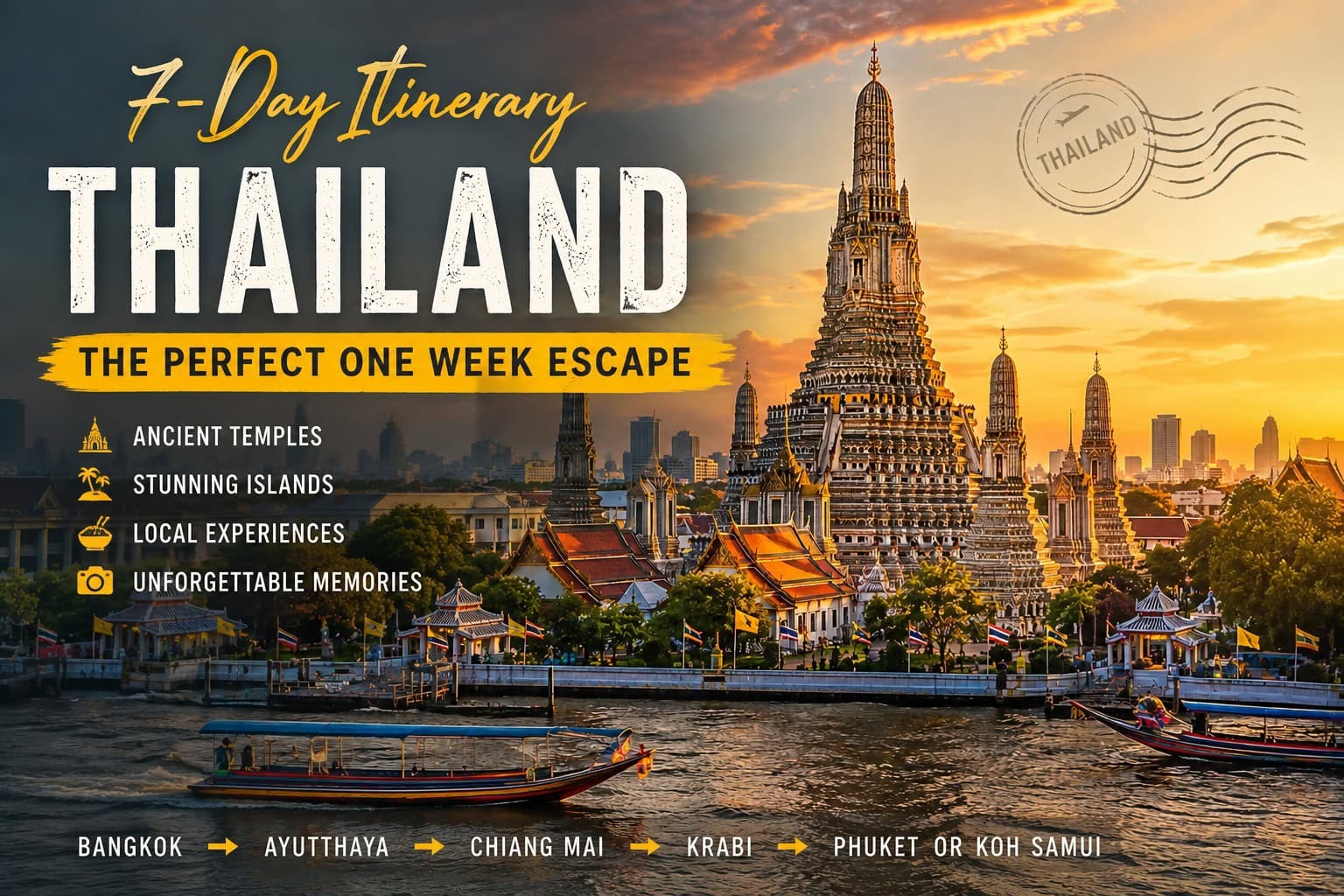
Thailand 7-Day Itinerary: How to Experience Thailand in One Week
Thailand doesn’t need weeks to leave a lasting impression. In just seven days, you can explore vibrant Bangkok, experience Thailand’s rich culture, taste incredible local food, and finish your trip on a tropical beach. The key is having the right plan, so you spend less time figuring out where to go and more time enjoying the journey.
Here’s what most travelers don’t realize: a Thailand 7-day itinerary isn’t about rushing to see every popular destination. It’s about choosing the right destinations that actually connect together, so you spend more time exploring and less time stuck on buses watching the landscape blur past.
Most people try to do too much. They bounce between Bangkok, Chiang Mai and Phuket all in one week, and by day five they’re exhausted from constant packing and unpacking. They get incredible photos but miss the actual feeling of being there.
But what if you could experience the real Thailand in seven days?
What if you could wake up in an ancient temple city one day, float through a limestone bay the next, and fall asleep on a tropical beach without feeling like you’re rushing through a checklist?
Let’s dig deep into it!
Why Seven Days in Thailand Is Actually Perfect?
Most travel guides make you feel like a week is too short. They’re wrong.
Seven days is exactly the right amount of time to experience Thailand’s magic. Here’s why travel experts keep recommending this window:
You avoid the “too fast, too slow” problem: Three days feels rushed. Two weeks can feel indulgent if you’re the type who gets restless. Seven days hits that sweet spot where you can linger without boredom.
You dodge constant hotel changes: This itinerary uses strategic bases, meaning you stay in one place for 2-3 nights and take day trips, instead of living out of a suitcase. Your brain actually relaxes when you unpack and stay unpacked.
The timing works with Thailand’s rhythms: Trains and flights naturally connect these destinations. You’re not fighting geography; you’re following it.
The money situation actually makes sense: More on this later, but seven days keeps costs manageable. You’re not blowing a monthly budget on a week away.
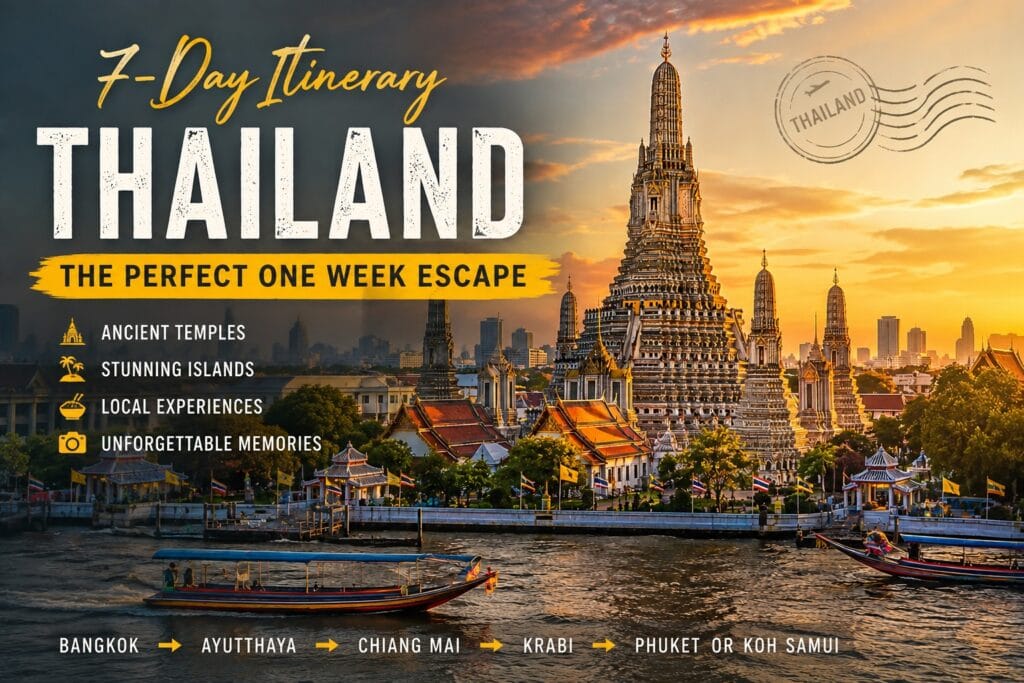
The Route: Thailand in 7 Days at a Glance
Before we dive into each destination, here’s where you’re going:
Day 1: Bangkok – Ancient temples and chaotic energy
Day 2: Ayutthaya – The old royal capital (day trip from Bangkok)
Day 3: Bangkok – Street food and river life
Day 4-5: Chiang Mai – Mountains, temples, and mountain villages
Day 6: Krabi – Limestone cliffs and island hopping
Day 7: Phuket or Koh Samui – Beach paradise before departure
Let’s go through them one-by-one:
Day 1: Bangkok: Where Chaos Actually Makes Sense
Settle Into Bangkok’s Rhythm
After you arrive and check into your hotel, resist the urge to immediately rush to famous attractions. Instead, take your first evening slowly.
Walk along the Chao Phraya River. Stop at a street vendor and order something you can’t pronounce maybe grilled fish cakes, maybe mango sticky rice. Sit beside the water and watch long-tail boats cut through the current while the sky shifts from orange to purple.
The Grand Palace: Early Morning Beats Everything Else
Most people visit the Grand Palace at noon and join 2,000 other tourists sweating through their clothes.
Go at 8:30 AM instead. The palace opens at 8:30, and for roughly 45 minutes, you get this extraordinary place with manageable crowds. The marble gleams. The golden roofs catch the first real light of the day. The air is still cool. Thai families visit for prayer +-actual worship, not just tourism.
Wat Pho: The Reclining Buddha That Stops You Cold
From the Grand Palace, walk 10 minutes to Wat Pho, home to a 46-meter-long reclining Buddha covered in gold leaf. You’ve probably seen photos. The photos don’t prepare you.
Standing in front of the Buddha’s face, which is as tall as you are, something shifts. Maybe it’s the scale. Maybe it’s the devotion that radiates from the place. Maybe it’s just that you’re finally here, in Thailand, in a 16th-century temple, and the moment is too big to photograph.
Thai Massage on Day 1
Before bed, get a traditional Thai massage.
Not the spa kind with cucumber water and new age music. A real Thai massage. You’ll lie on a mat in a modest room while someone essentially folds you into shapes you didn’t know your body could make. It’s intense. It’s uncomfortable. It’s absolutely transformative.
Day 2: Ayutthaya: The Ancient Kingdom (Day Trip)
Why Ayutthaya Matters Differently
Ayutthaya was the capital of Thailand for over 400 years (1351-1767). The temples here aren’t pristine museum pieces; they’re ruins. Actual ruins.
What makes ruins compelling is how they speak. A perfect temple tells you about power. A crumbling temple tells you about time. You feel history differently when you’re walking through places that the earth is slowly reclaiming.
The Temple Triangle: Three Essential Ruins
Your day in Ayutthaya focuses on three main temples that are close together:
- Wat Mahathat: The most famous, a massive prang (cone-shaped temple tower) with a Buddha head literally growing out of a tree root. You’ve seen this photo online. Being here, watching tourists take selfies with the Buddha head growing through the tree, feels surreal.
- Wat Ratchaburana: Right next to Mahathat. Two stunning prangs still standing, rising above the surrounding landscape. Climb the stairs inside the prang and look out over Ayutthaya. You’re inside a 600-year-old structure, looking at the same landscape Thai kings once saw.
- Wat Phra Si Sanphet: The largest temple in Ayutthaya at its height. Three massive prangs remain, standing in a line like guardians. The scale is breathtaking. Stand at the far end and let your eye travel across all three. This is what power looked like.
How to Actually Experience Ayutthaya
Tourist groups rush through here in 3-4 hours. Skip the rush.
Rent a bicycle. Yes, really. Ayutthaya is designed for bikes. Ride between temples at your own pace. Stop when something catches your eye. Buy coconut water from a vendor. Sit in temple courtyards and just be present.
Return to Bangkok
Evening train back (or bus—$3-5, 2 hours). Have dinner near your hotel and rest. Tomorrow you explore Bangkok more deeply.
Day 3: Bangkok Deep Dive: Street Food, Markets and River Life
Morning: The Floating Markets Before Anyone Else Arrives
Damnoen Saduak Floating Market is the most famous, but it’s also the most touristy (boats packed with selfie-stick wielders by 9 AM).
Instead, go to Amphawa Floating Market or Taling Chan. They open early, sometimes 5-6 AM, before tour groups arrive.
Imagine: longtail boats gliding through narrow canals lined with wooden houses. Vendors selling fresh produce, cooked noodles, fresh flowers, homemade desserts, all from boat to boat. The air smells like grilled shrimp paste and fresh mango. The light is soft and golden. Everything is real and functional, not staged for tourists.
Buy something warm: a bowl of noodles, fresh spring rolls, mango with sticky rice. Eat it sitting on a boat while the market comes alive around you. This is Thailand’s actual rhythm.
Mid-Morning: Temple Hopping Like a Local
Skip Wat Pho if you did it yesterday. Instead, visit smaller temples that tourists miss:
- Wat Benchamabophit (The Marble Temple): Made of white Italian marble, this temple is stunning and relatively quiet. Monks chant here in the early morning if you can wake up around 6-7 AM on a future morning, attending monk chanting is extraordinary.
- Wat Saket: On a hill overlooking Bangkok, with less-crowded courtyards and tremendous views of the city skyline.
Afternoon: Hua Lamphong Food Market or Chatuchak Market (Weekend Only)
If it’s the weekend, Chatuchak Weekend Market is the world’s largest weekend market. 15,000+ vendors. Everything from antiques to clothes to street food to live animals. You could spend six hours here and barely scratch the surface.
Evening: Chao Phraya River Dinner Cruise or Street Food Stall Dinner
Option 1: Take a dinner cruise on the Chao Phraya River. Watch Bangkok’s skyline light up. The city becomes almost magical at night, all those temples and palaces glowing against the dark.
Option 2: Skip the tourist cruise. Instead, find a street food area (Yaowarat for Chinese-Thai fusion, or anywhere with plastic stools and a crowd) and eat where locals eat. Grilled fish, som tam (spicy papaya salad), pad thai, fresh juice. Sit elbow-to-elbow with Bangkok residents having dinner.
Day 4-5: Chiang Mai: The Soul of Thailand
Today you fly north to Chiang Mai. From Bangkok, it’s a 1-hour flight or an 11-hour train (budget option, actually a beautiful overnight journey).
Why Chiang Mai Matters More Than You Think
Bangkok is Thailand’s modern face. Chiang Mai is Thailand’s soul.
This city was the capital of the Lanna Kingdom for centuries. The temples here reflect that history. The people move differently, more slowly, more deliberately. There’s something about the mountains and the distance from Bangkok’s chaos that changes the entire atmosphere.
Day 4 in Chiang Mai: Temples, Monks, and Mountain Views
Morning: Doi Suthep Temple
This temple sits on a mountain overlooking Chiang Mai. Drive or take a songthaew (shared red truck $1-2 per person) up the winding road.
From the temple platform, you look down at the entire city. It’s morning. Mist is lifting from the valley below. Monks are chanting somewhere inside. Thai incense hangs in the air.
Walk slowly through Doi Suthep. The temple is important; it’s where Bangkok royalty come to pray. But what matters to you isn’t the significance. It’s the moment of standing at elevation, looking at green mountains, understanding finally that you’re actually in Thailand.
Afternoon: Temple Frenzy
Chiang Mai has over 300 temples. You’re not visiting 300. You’re visiting the ones that speak to you.
Wat Chedi Luang: This ancient temple has a massive crumbling chedi (bell-shaped pagoda) in its center. The chedi is partially destroyed; an earthquake centuries ago split it. But that damage is part of its beauty. Monks still chant here daily.
Wat Phra Singh: A smaller, more intimate temple with gorgeous Lanna architecture and fewer tourists than Chedi Luang.
Evening: Monk Chat
Some temples offer “Monk Chat” literally, conversations with young monks learning English. Go to Wat Chedi Luang around 5 PM and look for the “Monk Chat” sign.
Sit with a monk for 30 minutes and talk about anything. Buddhism, travel, their daily life, philosophy, jokes. These conversations are unexpectedly profound. You’re not getting a lecture. You’re having a genuine exchange.
Day 5 in Chiang Mai: Waterfalls, Elephants, and Mountain Villages
Option A: Ethical Elephant Sanctuary
Chiang Mai is famous for elephant tourism. Most elephant camps are terrible: overworked animals, chains, exploitation.
If you want to see elephants, go to an ethical sanctuary. They’re real. Look for places where:
- Elephants are rescued (not bred for tourism)
- No riding or tricks
- Small group sizes
- You bathe elephants in rivers (they choose to be there)
Option B: Waterfall Trek
If elephants don’t call to you, trek to one of Chiang Mai’s waterfalls (Bua Thong, Doi Inthanon Waterfall). Hike through jungle canopy. Swim in natural pools. The waterfalls here are real limestone and streams cascading down mountainside, not tourist attractions.
Option C: Chiang Mai Night Bazaar and Night Markets
If you want a slower day, spend the afternoon at Chiang Mai Night Bazaar starting around 5 PM. Locals shopping, eating, browsing. Artisans selling handmade goods. Street food vendors cooking.
Find a food stall and order khao soi, a Chiang Mai specialty: thick noodles in rich curry sauce topped with crispy noodles. One bowl, $2. Life-changing.
Where to Stay in Chiang Mai
The Old City is the best neighborhood walkable, filled with temples, close to everything. Stay in a guesthouse or mid-range hotel rather than a chain. The local places have personality.
Day 6: Krabi: Limestone Cliffs and Island Dreams
From Chiang Mai, fly south to Krabi
You’ve been inland for 48 hours. Today, you remember why you came to Thailand: the beaches.
Krabi isn’t famous like Phuket. It doesn’t have Phuket’s infrastructure or Phuket’s partying energy. What it has instead is something rarer: dramatic beauty that still feels slightly undiscovered.
What Makes Krabi Different?
Krabi’s coastline is defined by massive limestone cliffs that rise directly from the water. Emerald lagoons. Caves you can kayak into. Islands accessible only by boat. It’s like someone took Thailand’s most dramatic elements and compressed them into one province.
Morning: Arrive in Krabi Town
Get a hotel in Ao Nang (the beach town, not Krabi Town, which is inland). Ao Nang is where travelers stay. Grab breakfast at a beachfront café. Fresh papaya, Thai coffee and a croissant.
Afternoon: Phang Nga Bay Kayaking or Four Islands Tour
Book a tour immediately upon arriving; they leave around noon-1 PM.
Option 1: Phang Nga Bay Kayak Tour:
You paddle your own small kayak through limestone cliffs. Guides take you into caves. You paddle through natural stone archways. It’s intimate, physical, and genuinely stunning. The light bounces off turquoise water and reflects on limestone. You’re inside a painting.
Option 2: Four Islands Tour:
A longtail boat takes you to four islands (Phra Nang Cave Beach, Chicken Island, Poda Island, Railay Beach). You snorkel, kayak, relax on beaches. More social, more sunbathing, less active.
This Day Changes Your Perception of Thailand!
After temples and markets and city chaos, your body remembers what it came for: the ocean. Salt water. Limestone majesty. The specific blue of tropical sea.
This day resets your nervous system. You’re moving, but you’re also finally relaxed.
Day 7: Phuket or Koh Samui: Beach Paradise Before Departure
Your final day is flexible. You can enjoy two options:
Option A: Phuket
Phuket is Thailand’s largest island and most developed beach destination. Patong Beach is famous for nightlife and partying. Kata and Karon Beaches are quieter, more family-friendly.
What to do in Phuket:
- Sleep until you want to wake up
- Eat breakfast at a beach café
- Swim in warm water
- Snorkel or dive if you want
- Get a final Thai massage
- Eat seafood dinner as the sun sets
Option B: Koh Samui
Koh Samui is an island off the east coast. It’s further from Krabi (requires ferry or flight) but worth it if you want something that feels more like an island escape.
Koh Samui has:
- Big Buddha Temple (scenic spiritual spot)
- Chaweng Beach (party vibe, like Patong)
- Lamai Beach (quieter)
- Emerald Lagoon and jungle hikes
- Better restaurants than you’d expect
The Departure: Reflecting on What You Just Did
Whether you fly out from Phuket or Koh Samui, your last moments in Thailand matter.
Sit somewhere by the water a café, a beach, anywhere. Think about the week:
- The moment at Wat Pho when you stood before the reclining Buddha
- Dawn at the floating market buying mango from a boat vendor
- Mist lifting over Chiang Mai from Doi Suthep
- Paddling your kayak through limestone caves
- Conversations with monks.
Planning a seven-day trip can be tricky when there are so many places to choose from. A well-planned itinerary helps you decide what to prioritize and how to make the most of your limited time. Read our blog on why having a travel itinerary matters before you start planning your route.
Signature Trips: Your Thailand Journey Planned Around You
A Thailand 7-day itinerary is only the beginning. The real question isn’t “what should I see in Thailand”; it’s “what kind of traveler am I, and how do I want to experience Thailand?”
Some people crave adventure (diving, jungle treks, elephant sanctuaries). Some crave culture (temples, monks, local immersion). Some want pure relaxation (beaches, spas, slow time). Some want everything mixed together. This itinerary gives you all of it. But tailoring it to your specific interests, pace, and travel style that’s where the real magic happens.
Signature Trips specializes in exactly this. We don’t give you generic itineraries. We build personalized Thailand travel plans around who you are as a traveler. Whether you want to add mountain villages, rock climbing in Railay, cooking classes, luxury villa stays, or something completely different, your itinerary can flex.
The goal isn’t to see everything. It’s to have the trip you actually want.
Ready to turn this itinerary into your personal Thailand journey? Signature Trips is here to help you build a 7-day Thailand experience that fits exactly how you want to travel.
Your adventure is waiting. Thailand is calling. The only question left is: when do you want to go?
FAQs
Is 7 days enough to visit Thailand?
Yes. Seven days is a great amount of time to experience Thailand without rushing. A well-planned itinerary can include Bangkok, Ayutthaya, Chiang Mai, Krabi, and either Phuket or Koh Samui.
How much does a 7-day trip to Thailand cost?
A comfortable 7-day Thailand trip can cost around 810–1,470 per person, excluding international flights. Budget travelers can spend less, while luxury travelers should plan for a higher budget.
What are the best places to visit in Thailand in 7 days?
The itinerary recommends Bangkok, Ayutthaya, Chiang Mai, Krabi, and Phuket or Koh Samui. This combination gives you a mix of culture, history, mountains, beaches, and adventure.
What is the best time to visit Thailand?
The best time for this itinerary is November to February, when the weather is generally dry, sunny, and cooler, making it comfortable for sightseeing and outdoor activities.
Should I visit Phuket, Koh Samui, or Krabi?
For this particular 7-day itinerary, Krabi is recommended because of its limestone cliffs, kayaking, island tours, and balance between adventure and relaxation. Phuket is better for nightlife, while Koh Samui offers a more island-focused experience.
Is it better to visit fewer places during a 7-day trip?
Yes. Spending more time in fewer destinations allows you to experience Thailand rather than constantly packing, unpacking, and traveling between cities.
How do I travel from Bangkok to Chiang Mai?
You can take a 1-hour flight or an overnight train of around 11 hours. Flying is faster, while the train offers a more scenic and memorable travel experience.
Is Thailand safe for solo travelers?
Thailand is generally suitable for solo travelers. However, travelers should stay in well-traveled areas, take care of their belongings, avoid risky late-night situations, and use common sense.
Do I need travel insurance for Thailand?
Travel insurance is recommended. The itinerary suggests choosing coverage that includes medical evacuation, trip cancellation, and lost luggage.
Can my Thailand itinerary be customized?
Yes. Signature Trips can personalize a Thailand travel plan around your interests, pace, and travel style. You can add experiences such as mountain villages, rock climbing, cooking classes, or luxury stays.


One Comment