
How to Pack for a Trip: Quick Travel Packing Guide
You’re leaving for your dream trip in three days and somehow you haven’t started packing. You’re standing in front of your closet, staring at your clothes, thinking how to pack for a trip and your mind goes blank. You’re imagining arriving at your destination and realizing you forgot something essential. You’re worried your suitcase will be too heavy. You’re stressed about fitting everything into a carry-on backpack.
Here’s what most travelers don’t realize: packing isn’t about fitting everything. It’s about choosing what actually matters. The difference between people who arrive at their destination feeling prepared and people who arrive feeling anxious isn’t how much they pack.
It’s how intentional they are about what they choose. Someone might pack 40 items and someone might pack 15, but the person who packed 15 feels more confident because they chose each item on purpose.
This travel packing guide by Signature Trips teaches you how to pack for any trip, whether you’re going for a weekend or a month, whether you’re backpacking through Southeast Asia or taking a family trip to Europe. The principles are the same. The only thing that changes is the duration and the climate.
The biggest mistake travelers make is packing based on fear.
- What if I get cold?
- What if I want to dress up?
- What if I need this thing?
Instead of packing based on your actual itinerary and your actual needs, you pack based on hypothetical scenarios that might never happen.
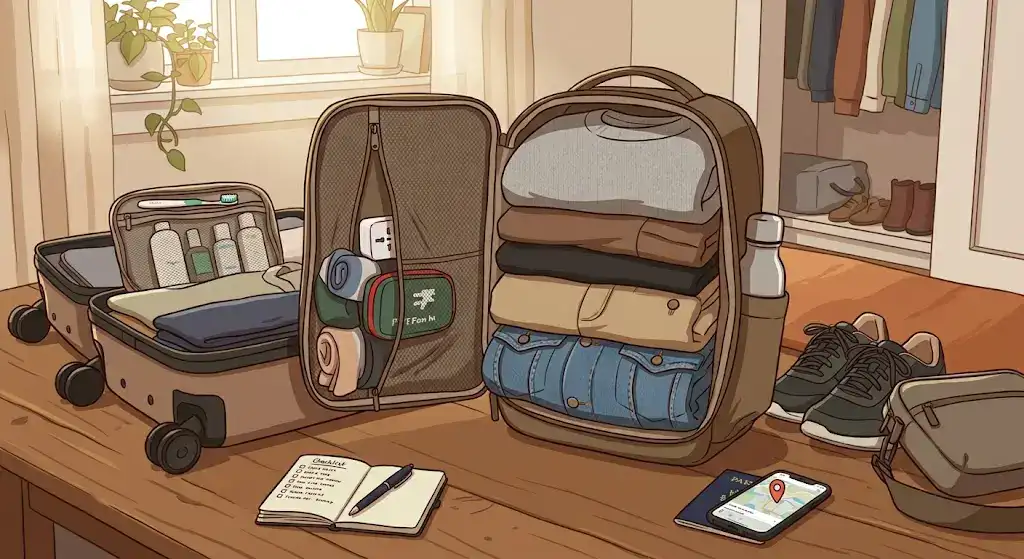
This changes today. This travel packing guide permits you to pack light. Permission to actually enjoy your trip instead of living out of an overstuffed suitcase.
Let’s dig into it!
The Art of Packing Light
Before we talk about what to pack for a Europe trip or how to pack a suitcase efficiently, let’s talk about why packing light actually matters beyond just practical reasons.
When your luggage is heavy, your entire trip feels heavier. You move slower. You get more tired. You’re less likely to explore neighborhoods because you’re dragging a suitcase. You’re less likely to take day trips because your stuff feels like an anchor.
When your luggage is light, everything changes. You can pick it up with one hand. You can move through airports faster. You can take your bag into a cafe if you want. You can suddenly go somewhere spontaneously because you’re not worried about leaving your stuff behind.
Light packing creates freedom. That’s the real magic of it!
Most people can travel comfortably for two weeks with a carry-on backpack. Most people can do a month with a small checked bag. Most people don’t need half of what they pack.
The travel checklist that actually works starts with one principle: pack items that do multiple jobs. A neutral colored sweater works as a light jacket, as a layer and as something to throw over a dress if you want to dress up. A pair of black pants works with almost everything. A white shirt goes with everything and can be dressed up or down.
Steps for Packing Light for a Trip
Follow these steps if you want to travel light and enjoy the trip:
Step 1: Choose Your Base Wardrobe
The foundation of how to pack a suitcase efficiently starts before you even touch your closet. You choose a color palette. This sounds boring, but it’s genuinely the most important decision you make.
Choose three colors maximum. Most travelers do neutral tones:
- Black
- White
- Navy
- Gray
- Beige
- Brown
This means everything you pack works together. A black shirt works with your navy pants. Your gray sweater works with your white pants. Everything coordinates without planning.
Everything you pack must coordinate with everything else you pack. This sounds restrictive, but it’s actually freeing because you never have the problem of packing something that doesn’t go with anything else.
From this base color palette, choose five to seven tops, two to three bottoms, and one dress or outfit for dressing up. That’s your foundation. If you’re going for a weekend trip packing list, that’s probably all you need.
Step 2: Layers for Temperature
The biggest packing mistake is packing too many clothes for each season. Instead of packing multiple thick sweaters, pack one sweater and one light jacket. Instead of packing five short-sleeved shirts, pack three and a lightweight long-sleeved shirt that works as sun protection and layering.
Layers are your friend. A t-shirt plus a cardigan plus a light jacket gets you through almost any weather situation. The same three pieces worn different ways look like six outfits.
For what to pack for Europe trip in spring or fall, bring lightweight layers. One pair of jeans, one pair of neutral pants, two to three short-sleeve tops, one long-sleeve top, one cardigan, one light jacket, one pair of comfortable shoes, one pair of dressier shoes. That’s it. That’s a complete wardrobe for a week in Europe and you still have room in your suitcase.
For summer trips, bring fewer layers. For winter trips, bring thicker pieces but fewer of them. The principle stays the same: quality over quantity. One good winter coat beats five mediocre sweaters.
Step 3: The Practical Items
After your base wardrobe, everything else on your travel checklist should be functional.
- Socks and underwear for the trip plus one or two extra.
- Pajamas.
- One pair of athletic shoes or casual walking shoes.
- One pair of dressier shoes. One pair of sandals or casual shoes.
That’s it for footwear. Most travelers bring too many shoes.
For backpacking essentials or family trip packing, include a lightweight rain jacket that packs small. One pair of shorts if you’re going somewhere warm. One pair of athletic clothes if you actually work out. Most people pack athletic clothes and never wear them. Only pack them if you genuinely work out.
Toiletries are where people lose their minds. You do not need your entire bathroom. You need:
- Deodorant
- Toothbrush
- Toothpaste
- Face wash
- Shampoo
- Conditioner
- Sunscreen
Everything else either buy there or skip. Seriously. You don’t need seven different products. Most places have shampoo. You can buy lotion when you arrive. You can get pain relief medication at any pharmacy.
Travel essentials for women might include period products, though these are available everywhere now. Any specific medications you need. A small sewing kit for emergencies. That’s truly all you need beyond the basics.
Step 4: The Right Suitcase or Backpack
How to pack a suitcase efficiently depends partially on what suitcase you choose.
- A rigid hard-shell suitcase is easier to pack because compartments are structured.
- A soft-sided roller bag compresses better if you need to squeeze things in.
- A backpack is ideal for people moving frequently because it’s easier to carry.
Most travelers do well with a carry-on roller bag for trips up to two weeks. It’s small enough to fit in airplane overhead bins, large enough to hold everything you actually need and rolling makes it easier to navigate airports.
For weekend trip packing, a personal backpack or small roll-on works. For longer trips like backpacking essentials for a month, a larger backpack around 40 to 50 liters works better.
The suitcase doesn’t matter as much as what you put in it. The best suitcase is the one you’ll actually use and that fits your travel style. Someone moving between countries weekly needs a backpack. Someone going on a family trip packing needs a roller bag. Someone taking a weekend trip packing list needs a small bag.
Step 5: Rolling Versus Folding
How you pack your suitcase matters less than you think.
- Rolling saves space slightly.
- Folding is neater.
Pick whichever makes sense for your suitcase type and move on. This isn’t the thing that determines whether your packing works or fails.
What actually matters is putting heavier items on the bottom and lighter items on top. Putting shoes around the edges and filling the center with clothes. Packing socks inside shoes to maximize space. Putting everything you need to access first on top or in outside pockets.
If you’re worried about wrinkles, pack items that don’t wrinkle. Cotton wrinkles, linen wrinkles, silk wrinkles. Polyester blends and technical fabrics don’t. Most travel companies now make clothes specifically designed not to wrinkle. Pack those instead of worrying about packing technique.
The Travel Checklist That Actually Works
Start with the question: where am I going and for how long? This determines everything. A weekend trip packing list in a city looks different from a weekend trip packing in the mountains. A family trip packing for the beach looks different from a family trip packing for hiking.
Once you know your destination and duration, ask: what activities am I actually doing? If you’re hiking every day, pack hiking shoes. If you’re visiting museums, pack comfortable walking shoes. If you’re going to restaurants, pack one nicer outfit. If you’re staying in hostels, you don’t need dressing-up clothes.
- For a weekend trip: For this packing list, you need five to seven tops, two bottoms, one pair of walking shoes, one casual pair, one pair of socks and underwear for each day plus two extra, toiletries, phone charger, medications, and one light layer.
- For a week trip: Double some of those items. For backpacking essentials for a month, you need the same five to seven tops but you’ll wash them during the month. You still only need two pairs of bottoms. You still only need three pairs of shoes.
- For family trip packing: Add children’s versions of the same items plus any specific medications or supplies kids need. Don’t overpack kids’ clothes thinking they’ll get dirty. They wear the same outfit for days and then you wash it.
- For what to pack for a Europe trip: Specifically, bring comfortable walking shoes because European cities involve lots of walking. Bring layers because weather changes. Bring neutral colors that work together. Bring one dressier outfit for nice restaurants. Bring a compact rain jacket. Bring a scarf that works as a layer and as a head covering if you visit religious sites.
Packing for Indonesia? From tropical weather to beach days and cultural excursions, knowing what to expect can make your packing much easier. Our guide, There Were Whispers About Indonesia, They Were Right, can help you get a better feel for the destination before you decide what to bring.
Special Items That Actually Matter
- Phone charger: This is non-negotiable. Bring the charger and a power bank.
- Travel adapter: Different countries have different outlets. A universal adapter that works in multiple regions costs 10 to 20 dollars and solves this completely.
- Small first aid kit: Bandages, pain relief, anything you take regularly. Most things you can buy, but having basics avoids stress.
- Pen: You need a pen more often than you think. For forms, for writing down addresses, for leaving notes. One pen takes no space.
- Copies of important documents: Passport copy, travel insurance info, hotel addresses. Keep these separate from originals.
- Cash in the local currency: Carry maybe 50 to 100 dollars equivalent in local money. Some places don’t take cards.
What To Leave Behind
Here’s permission you didn’t know you needed: you do not need to bring most of what you’re thinking about bringing.
- You do not need eight pairs of shoes. You need two to three maximum.
- You do not need a separate outfit for each day. You need outfits that repeat.
- You do not need your entire makeup bag. Bring your essentials. Leave the rest.
- You do not need multiple bags to match multiple outfits. Bring one good bag that works with everything.
- You do not need a blow dryer, or curling iron unless you absolutely cannot function without it. Even then, most hotels have blow dryers.
- You do not need every medication you own. Bring what you actually take regularly.
- You do not need formal clothes unless you’re actually going to formal events. Leave the fancy stuff at home.
- You do not need your full wardrobe. You need a wardrobe that works together.
The Final Step:
The best way to learn how to pack a suitcase efficiently is to actually pack light once and see what happens. Pack half of what you normally pack for your next trip. See what you actually need. See what you don’t touch. This teaches you more than any guide can.
Most travelers discover on their first light packing trip that they packed way too much on every previous trip. They realize they wore five outfits the entire week. They realize they brought ten shirts and wore four. They realize they were dragging around weight for no reason.
This experience changes how you pack forever. Suddenly, how to pack for trip becomes obvious because you understand what you actually need versus what fear tells you to pack.
Plan Your Trip with Signature Trips
Packing is only one part of having a stress-free journey. Signature Trips helps you plan the trip around your destination, duration, activities and travel style, so you know exactly what to expect before you leave.
From carefully planned itineraries and hotel bookings to local experiences and personal travel support, we help turn your travel ideas into a well-organized trip. You focus on enjoying the journey; we take care of the planning.
FAQs
How can I pack light for a trip?
Pack only what you genuinely need based on your destination, trip duration, and planned activities. Choose versatile clothing that can be mixed and matched.
How many clothes should I pack for a week-long trip?
A practical starting point is 5–7 tops, 2–3 bottoms, one dressier outfit, and layers suitable for the weather.
Is it better to roll or fold clothes when packing?
Both methods work. Rolling can save a little space, while folding keeps things neat. What matters more is how you organize the suitcase.
How many pairs of shoes should I take on vacation?
Ideally, limit yourself to 2–3 pairs: comfortable walking shoes, a dressier pair, and optionally sandals or casual shoes.
What should I pack for a Europe trip?
Bring comfortable walking shoes, lightweight layers, neutral-colored clothing, a dressier outfit, a compact rain jacket, and a scarf.
What are the most important travel essentials?
Don’t forget your phone charger, power bank, universal travel adapter, basic first-aid items, pen, copies of important documents and some local currency.
What should I pack for a weekend trip?
Focus on versatile clothes, comfortable shoes, toiletries, your charger, medications and one light layer. Avoid packing items you probably won’t use.
How can I avoid overpacking?
Plan your packing around your actual itinerary instead of hypothetical situations. Pack outfits that can be repeated and items that serve multiple purposes.
What suitcase is best for traveling?
A carry-on roller works well for trips of up to two weeks, while a 40–50 liter backpack can be useful for longer trips or frequent travel between destinations.
How do I know what I actually need to pack?
Consider your destination, trip length, weather, and activities. You can also try packing about half your usual amount and see what you actually use during the trip.




One Comment